Visiting Egypt as a Woman: An Egyptian-American Guide
By ZeePublished August 20, 2026 (updated October 22, 2026)16 min read
Egypt is one of the most visited countries on earth, and the horror stories you read online usually come down to a few predictable things: pushy vendors, touts and unwanted attention. This guide from an Egyptian-American woman explains why they happen, what to say and do, and how to enjoy Egypt without the stress.

On this page
- Is Egypt Safe for Women Traveling Alone?
- Will I Get Hassled in Egypt?
- What Should Women Wear in Egypt?
- How Do I Get Around Egypt Without the Stress?
- How Do I Handle Street Vendors and Constant Attention?
- What Are Bathrooms Like in Egypt?
- Is the Food and Water Safe in Egypt?
- What Medications Can I Bring Into Egypt?
- What Is It Like to Travel Egypt with Starlight Voyages?
- Frequently asked questions
Key facts
- Biggest hassle
- Persistent vendors and touts, mostly in Cairo's markets
- What ends it
- A calm hand on your heart and a firm "La, Shukran"
- Backup
- Tourist police at every major landmark and transit hub
- Getting around Cairo
- Uber or a vetted private driver, not street cabs
- Between cities
- About an hour by EgyptAir, roughly $120 USD each way
- What to wear
- Lightweight UPF long sleeves and wide-leg linen pants, for the sun
- Tipping
- Keep small bills; budget $15 to $25 USD per day for a private Egyptologist
- Our group size
- 10 to 12 guests, hosted by Abdul and Anna
Practical packing advice, cultural translation, and street sense from someone who lives in both worlds.
Every time a friend tells me she is planning a trip to Egypt, she asks me about safety in a whisper like she is planning an extraction mission.
I have to tell them to take a breath. You are going on vacation! To one of the most visited places in the world! Through literally all of time!
I grew up in the States, but my family is Egyptian. My brother Abdul runs trips there every year, and friends constantly text me in a panic before packing their bags. They have spent three months online reading horror stories written by people who spent two days at a tour bus hotel in Giza and never spoke to an actual Egyptian.
Cairo is loud, alive, and ancient. People here have a baseline level of hospitality that catches Westerners off guard. If you look lost on a sidewalk in Cairo, three people will stop to give you directions at the same time. If you sit down in a shop, someone will hand you a cup of hot tea before you have even looked at a price tag. Egypt features a unique blend of North African culture with Middle Eastern hospitality.
You do not need to walk around on high alert. You just need a few basic pointers from someone who understands both sides of the culture. Here is the unvarnished advice I give my own friends before they pack.
“Visiting Egypt had been on my bucket list forever, but as a solo female traveler I felt intimidated to book a trip alone. I jumped at the chance to visit with Abdul and Anna, because I knew with their travel experience, local knowledge, and passion for Egyptian history I was in the best possible hands”, Emily S (2026)
Is Egypt Safe for Women Traveling Alone?
Yes. Violent crime against tourists in Egypt is very, very rare, and Egyptian society takes hospitality very seriously. The reality is that the Egyptians know tourism is their primary income, so as a tourist you are the most protected class in the country.
If you ask people who have never been, they picture a war zone. If you ask women who actually travel here, they will tell you the real challenge is not physical safety. It’s being overstimulated.
Cairo has 20 million people (20 million and 1 if you come!), intense traffic, and shopkeepers who make a living by trying to sell you alabaster statues and papyrus bookmarks. That is street commerce, not danger. Once you understand that distinction, the nervousness drops away. In fact these shopkeepers are heavily monitored by tourist police that you will see at every corner (with the cool land cruisers!)
Local culture is family-oriented and protective of visitors. If someone gives you a hard time on the street, nearby shop owners or bystanders will usually step in and shut it down before you even have to. The likelihood of this happening is very slim, especially with a guide like Starlight Voyages provides!
What You Actually Need to Know
- Violent crime is rare: tourist police are stationed at every major landmark and transit hub, and penalties for harassing travelers are severe.
- The biggest hurdle is street persistence: market vendors in Cairo can be relentless, but a calm hand on your heart and a firm "La, Shukran" ends the conversation.
- Solo does not have to mean alone: many women travel solo to Egypt by booking private vetted drivers or joining small curated groups so they can skip the logistical exhaustion and just enjoy the country.
Will I Get Hassled in Egypt?
Some of the stories online are true, so here is the honest version. Women travelers do sometimes get unwanted attention in Egypt, mostly in crowds, markets and on public transport, and government travel advice says so too. For most visitors it comes down to shouted compliments and persistent vendors, which is more annoying than frightening.
A few habits handle nearly all of it:
- Keep walking. Sunglasses on, eyes forward, no need to engage.
- Say "La, shukran" (no, thank you) once, with a hand on your heart, and mean it.
- Head toward people. Shops, families, hotel staff and the tourist police at every major site are all easy places to step into.
- Skip street taxis. Use Uber or a vetted driver, which UK travel advice also recommends over riding alone.
- On the Cairo metro, ride the women-only car.
None of this is a reason to stay home. It is a reason to arrive with a plan.
“…we all looked out for one another while making incredible memories.”, Emily S., solo female traveler, Egypt 2026
This is the part of Egypt a small group takes off your plate. On our trips there are no street taxis to negotiate and no gates to figure out alone. You have private vetted drivers, licensed native Egyptologists at every major site, a team in Cairo you can reach any time, and 10 to 12 other travelers who quickly become friends. See how the February 2027 trip works.

What Should Women Wear in Egypt?
The biggest misconception online is that covering up in Egypt is purely about conservative religious rules. Egypt is actually a very liberal and cosmopolitan country with vibrant nightlife, rooftop lounges, and modern cafes. While dressing with modesty is polite, the real reason to cover up is much older and far more practical!
Egypt has a brutal UV index. Even on our February trips when the morning air feels crisp, the midday sun bounces hard off limestone pyramids and sandstone temples. If you wear denim shorts and a tight tank top to the Giza Plateau, you will not just get stares. You will be sunburned and miserable within an hour. Covering up is your sun armor.
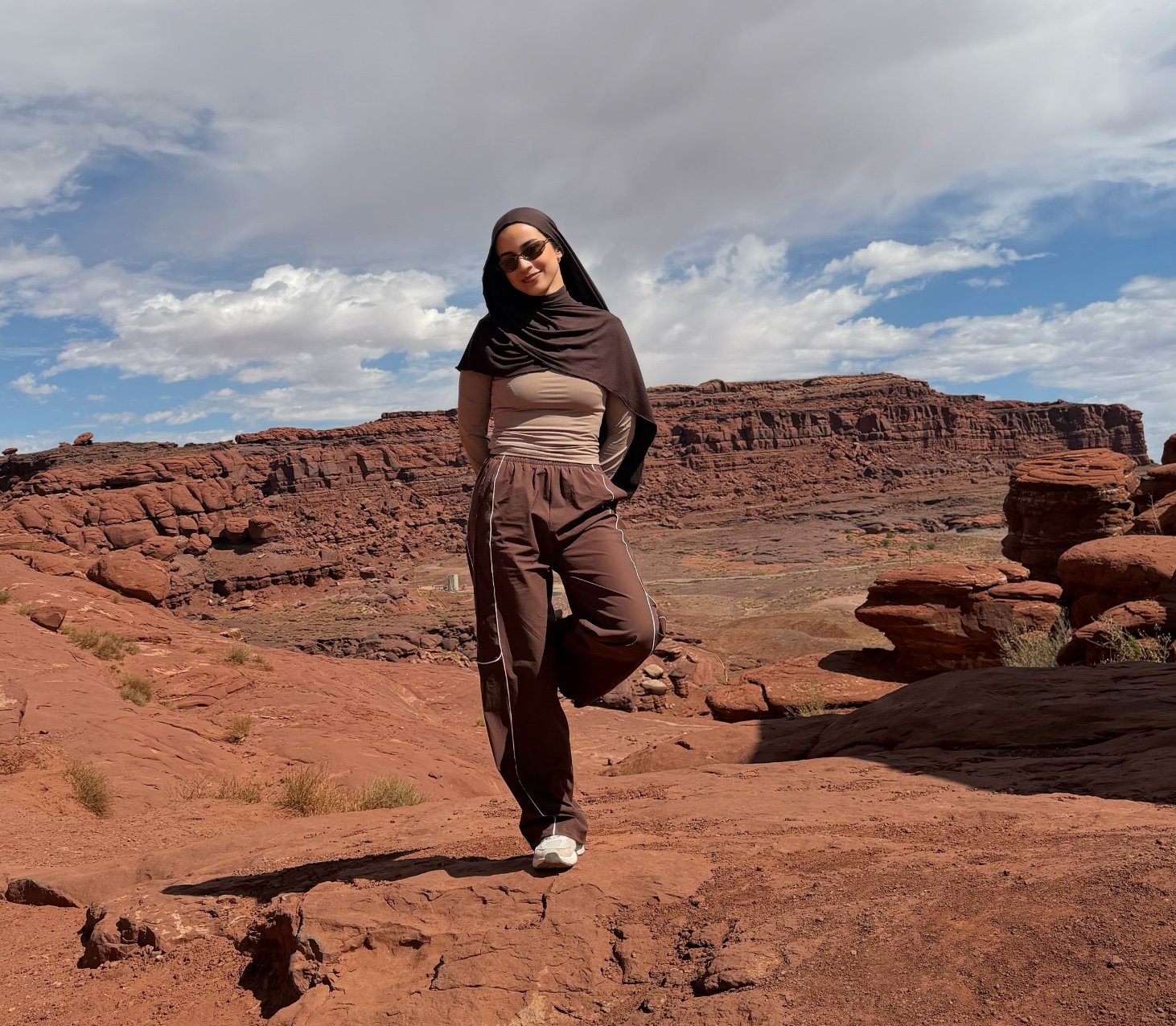
My sister in law Anna is OBSESSED with sun protection and swears by technical UPF clothing from brands like Coolibar and REI. Packing a mix of lightweight UPF long-sleeve shirts and airy, wide-leg linen pants is the smartest move you can make.
Quick Clothing Summary for Packing
- Pack wide-leg linen pants and breathable midi or maxi skirts.
- Bring loose linen button-downs or lightweight UPF long-sleeve tops from brands like Coolibar or REI.
- Choose earth tones, terracottas, and olive greens. They look great against sandstone temples and do not show desert dust.
- Keep a light cotton scarf in your day bag for sudden sun or stepping inside historic mosques. Don’t have one? Great! Buying one is part of the Egypt experience as this is one of the most common things street vendors have.
- Leave pristine white sneakers at home. Bring broken-in walking shoes or trail sandals with real grip for dusty, uneven temple stones.
(We put together a full breakdown of specific brands, fabrics, and gear in our complete Egypt packing list guide.)


How Do I Get Around Egypt Without the Stress?
If you ask anyone who had an exhausting time in Egypt what went wrong, nine times out of ten the answer is logistics.
Egypt is an ancient country with a very modern, sprawling transit puzzle. Cairo is one of the densest cities in the world, with traffic that functions like an organic river. Lanes are mostly suggestions, honking is a language of its own, and navigating across town from your hotel to the Grand Egyptian Museum can take forty minutes or two hours depending on the time of day.
Add in domestic travel between Cairo, Luxor, and Aswan, and managing every detail yourself turns into a part-time job while you are supposed to be on vacation.
Here is the practical reality of how getting around actually works:
Is It Safe to Take Taxis and Ubers in Cairo?
- Avoid flagging white street cabs off the curb if you do not speak Arabic. You will have to negotiate prices before getting in, drivers rarely use meters for tourists, and few speak fluent English.
- If you ever have to take a taxi alone, share the driver's details, your trip and your live location with a friend before you go.
- Uber works very well in central Cairo and (usually) takes the price haggling out of the equation since charges run through the app. Pro tip - if the driver is trying to get any more money from you outside of the Uber fare, canceling and finding a new driver is penalty free on Uber Egypt app!
- For full sightseeing days, booking a private vetted driver through a trusted local operator is the best move. Having an air-conditioned car waiting for you outside the Egyptian Museum so you can drop your bags and cool off is worth every penny.
What Is the Best Way to Travel Between Cities?
- The overnight sleeper train between Cairo, Luxor, and Aswan is a classic backpacker staple, but it is notoriously bumpy, delays are common, and bathrooms can be rough.
- If your time is limited, take domestic flights on EgyptAir. They take about an hour between Cairo and Luxor or Aswan, saving you twelve hours of exhaustion on rails. These go for about $120 usd each way.
- Between Luxor and Aswan, the best way to travel is on the water. A multi-day Nile cruise or private dahabiya turns a long road transfer into the most relaxing part of your trip, drifting past date palms and quiet riverbanks between temple stops.
Do I Need a Tour, or Can I Do Egypt on My Own?
At Starlight Voyages, we specialize in deep, thoughtful exploration. Our curated Egyptian expeditions take the guesswork out of logistics, providing you with trusted local connections, expert guides, and seamless transport. We handle the details so you can focus on the wonder.
Can you piece all this together completely on your own? Of course you can. Plenty of people do.
The question is how you want to spend your energy.
When you spend your mornings figuring out train ticket lines, negotiating with taxi drivers outside temple gates, and verifying which entrance to the Giza Plateau has fewer touts, your mental battery drains fast. By 2 PM, you are tired and on edge.
Having a dedicated local team handling the movement behind the scenes changes your entire experience of the country. A driver who knows the back roads picks you up at the terminal. A native Egyptologist guide walks you past the ticket chaos directly into Karnak Temple. Cold bottles of water are waiting in the van whenever you step out of the desert sun.
You stop managing travel friction and start actually soaking in where you are.
“…the love & care I felt from his family & from him throughout the trip was amazing.”, Shannon, Egypt 2026
Rather not figure Egypt out alone?
Our small-group trip is hosted by Abdul and Anna, with licensed native Egyptologists at every major site, private vetted drivers, and a team on the ground in Cairo. Ten to twelve guests, no tour buses.
See the Egypt small group tour
How Do I Handle Street Vendors and Constant Attention?
Cairo is a city of over 20 million people. It is loud, chaotic, and full of life. In places like Khan el-Khalili, vendors are vocal and persistent because they are running a business in an aggressive market. They are not trying to threaten you and the vast majority of your interactions with them will be playful. They may call you something like Shakira or Princess Diana as a way to make you laugh and earn their favor but that’s the typical limit of the interaction. If you are actually interested in what they are selling (a scarf, wallet, sometimes handmade weavings etc) feel free to show interest and negotiate a price.
Put on a pair of sunglasses so you can look around without making accidental direct eye contact with every shopkeeper you pass. If someone offers you a souvenir or a cab you do not want, place your right hand over your heart, give a quick smile, and say a clear "La, Shukran" (No, thank you). Say it once, keep walking, and do not break your stride. In Egypt, that hand-on-heart gesture communicates respectful finality.
Remember that Cairo is where almost all the intense street energy lives. Once we head south to Aswan and board the Nile cruise, the pace slows down 1000x. For many this is where the “travel” ends and the “vacation” begins!
Down on the river, you spend your days exploring ancient tombs with your guide and watching palm trees drift past from the sun deck. You will have plenty of free time to wander local markets on your own, especially in Luxor (my personal favorite market in the country) and in the colorful Nubian villages in Aswan. You should feel relaxed, safe, and confident doing so.
How Much Should I Tip in Egypt?
If you ask Western travelers what caught them most off guard about Egypt, tipping is almost always at the top of the list. In Arabic, it is called baksheesh, and it is woven into the fabric of daily life.
Coming from the US or Europe, reaching into your pocket multiple times an hour can make you feel like everyone is trying to nickel-and-dime you. But once you understand the economics, you realize it is just how the service ecosystem works.
Salaries in Egypt are modest, and tips are an essential way working people feed their families and share in the tourism economy. While the interactions happen frequently, the actual dollar amounts are tiny.
The Golden Rule: Stash Small Bills
The secret to frictionless tipping is keeping a dedicated stash of small bills in an outer pocket or pouch so you never have to pull out a wallet full of cash. I literally keep a “tips only” pocket and an “everything else” pocket in my bag.
Whenever you break a 100 or 200 Egyptian pound note at a cafe or hotel, save the 5, 10, and 20 pound bills.
- Bathroom attendants: 10 to 20 LE (roughly 20 to 35 cents USD).
- Luggage porter at your hotel: 20 to 50 LE per bag (35 cents to a dollar).
- The tomb guard who points a flashlight at a hidden hieroglyphic carving in the Valley of the Kings: 20 to 30 LE. You are not obligated to tip if you do not want their help, but if they show you something cool or take a great photo of you with your phone, handing them a small bill is polite.
Your Tour Guide and Drivers: The Envelope Method
For the professionals who spend the entire day looking after you, tipping works differently. You do not tip your private driver or licensed Egyptologist after every single temple stop; that would be awkward for everyone.
Instead, budget a daily amount and hand it to them in a tip envelope at the very end of your trip (or at the end of their service):
- Private Egyptologist Guide: budget roughly $15 to $25 USD per day total from your group. If you are on a group tour, guests usually pool together roughly $10 to $15 USD per person per day.
- Private Van Driver: budget roughly $10 to $15 USD per day total for navigating Cairo traffic and keeping the AC ice cold.
When you add up all those loose 10-pound notes throughout a full day of sightseeing, you might only spend two or three dollars total. It feels frequent, but the financial impact on your travel budget is negligible, and it makes a world of difference to the people helping you explore their home.
Check out our full blog on Budgeting for Egypt!

What Are Bathrooms Like in Egypt?
One of the most searched questions on Google is: Should I bring toilet paper to Egypt?
Yes, there is a handheld bidet sprayer (called a shattaf) next to almost every toilet in Egypt. Test the water pressure with a gentle squeeze before you aim it at yourself unless you want a surprise.
Once you get used to washing with water, using only dry paper feels kind of gross anyway. I still recommend you pack tissues (we bring extra!) so that you can dry yourself fully.
Public Restroom Essentials
- Always keep a pack of pocket tissues and travel hand sanitizer in your bag. Desert rest stops and temple stalls sometimes lack paper rolls. Although honestly last time I was there they were pretty good about it, no promises though!
- Restroom attendants near monuments hand you a few squares of tissue at the door. Tip them 5 to 10 Egyptian pounds (about 20 cents USD). Keep loose small bills at the ready in general anyway since tip culture is big.
- Do not flush paper. Older Egyptian plumbing cannot handle it. Used tissues go in the small waste bin beside the toilet.
Is the Food and Water Safe in Egypt?
Nobody wants an upset stomach on vacation, but hiding in a hotel eating bland international buffets means you miss the soul of Egyptian culture.
- The water rule: stick strictly to sealed bottled water for drinking and brushing your teeth. While 5-star hotels in Cairo have advanced filtration, why gamble your vacation on hotel plumbing? On all our Starlight Voyages trips, cold sealed bottled water is stocked constantly in our private vans, your hotel rooms and at every site.
- Street food is great when it is hot: Busy spots with high turnover are safe, if the locals are eating there, get in line! Try fresh koshary (the national dish of rice, lentils, macaroni, chickpeas, and spiced tomato sauce) or hot ta'ameya (Egyptian falafel made from fava beans). Because it comes straight out of boiling oil, it is fresh and safe.
- Fresh fruit juice: Cairo has amazing juice shops that press fresh mango, pomegranate, and sugarcane (asab) right in front of you. Pick busy shops and ask for no added ice if you want extra peace of mind.
- Bring the basics: Pack electrolyte packets, Pepto-Bismol, and Imodium just in case your digestive system needs a day to adjust to new spices.
What Medications Can I Bring Into Egypt?
Egypt has strict border regulations about prescription medications, and it catches travelers off guard every year.
Over-the-counter painkillers like ibuprofen (Advil) and acetaminophen (Tylenol) are completely fine to pack for personal use.
However, medications containing codeine, tramadol, or pseudoephedrine (the active decongestant in standard American cold medicine like Sudafed) are tightly controlled or banned at Egyptian border entry. Bringing unverified bottles into Cairo airport can lead to confiscation and delays.
Keep all prescription medications in their original pharmacy bottles with your legal name clearly printed on the label. Carry an official letter from your doctor stating what the medication is and why you need it, and keep it in your carry-on bag, never in checked luggage.
“What I didn't expect was how lovely the group of people attending were. I've created friendships with such considerate caring people on this trip that I hope to stay in touch with forever.”, Emily S., solo female traveler, Egypt 2026
What Is It Like to Travel Egypt with Starlight Voyages?
Join Our Curated Small Group Expeditions
If you love the idea of traveling with a community where every detail is taken care of, our small group trips are built for you. Solo travelers do well on our February 2027 departure, and the full itinerary for the small-group Egypt tour is on the trip page.
- Capped at 10 to 12 guests: No massive tour buses or giant groups. We keep trips intimate so we can move easily and access quiet spaces.
- Hosted by our family: You travel with Abdul, Anna, and licensed native Egyptologists who know the history, the language, and the local spots.
- Professional photography included: Abdul photographs our guests throughout the entire journey, so you come home with stunning, high-resolution portraits at ancient monuments instead of rushed phone photos.
- Family dinner in Cairo: Every group trip includes an evening in our family home in Cairo, sharing traditional dishes like my Aunt's famous basbousa and talking about real life in Egypt.

Custom Itineraries for Private Groups and Families
If you already have your own group, like a family trip, a mother-daughter getaway, or a private circle of friends, we can design a bespoke journey around your dates.
- Built around your schedule: Choose how many days you want to spend exploring Cairo, sailing the Nile on a private boat, or relaxing on the coast.
- Private drivers and local guides: Your group travels in private air-conditioned vans with vetted drivers and trusted local experts at every stop.
- Zero logistical headaches: We coordinate hotels, transfers, domestic flights, tickets, and reservations, leaving you free to enjoy your trip.
Frequently asked questions
Is Egypt safe for women traveling alone?
Serious crime against tourists is rare and tourist police are stationed at every major landmark and transit hub. The realistic challenge is street attention and persistent vendors, especially in Cairo's crowds and markets. Most women handle it easily with a few simple habits, a vetted driver, and a small group.
Will I get hassled in Egypt?
Some women get unwanted attention, mostly in crowds and markets, usually shouted compliments or persistent vendors. Keep walking, say a calm "La, Shukran" with your hand on your heart, and head toward shops, families or tourist police. Most women find it easy to manage with a few habits and a vetted driver.
What should women wear in Egypt?
Dress for the sun first. Egypt has a brutal UV index, so lightweight UPF long sleeves and wide-leg linen pants are the smartest move. Egypt is cosmopolitan, so you do not need to hide. Carry a light cotton scarf for stepping inside mosques.
Is it safe to take taxis alone in Egypt?
Avoid flagging street cabs if you do not speak Arabic: prices are negotiated and drivers rarely use meters. Uber works very well in central Cairo, and a private vetted driver is the best move for full sightseeing days. UK advice is to share your driver's details and live location.
Is it worth joining a group as a solo woman?
Many women travel solo to Egypt by booking private vetted drivers or joining small curated groups, so they can skip the logistics and enjoy the country. Our trips cap at 10 to 12 guests, hosted by Abdul and Anna with licensed native Egyptologists. Solo travelers do well on our February 2027 departure.
How much should I tip in Egypt?
Keep a dedicated stash of small bills. Bathroom attendants get a small bill (5 to 20 LE depending on the stop), a luggage porter 20 to 50 LE per bag. Budget roughly $15 to $25 USD per day total for a private Egyptologist and $10 to $15 USD per day for a private van driver.
Is the water and food safe in Egypt?
Stick strictly to sealed bottled water for drinking and brushing your teeth, even though five-star hotels in Cairo have advanced filtration. Street food is safe when it is hot and busy, and fresh juice is great from busy shops, ideally with no added ice.
What medications can I bring to Egypt?
Over-the-counter painkillers like ibuprofen and acetaminophen are fine. Medications containing codeine, tramadol, or pseudoephedrine are tightly controlled or banned. Keep prescriptions in original bottles with your name on the label and a doctor's letter in your carry-on.
Should I bring toilet paper to Egypt?
There is a handheld bidet sprayer, called a shattaf, next to almost every toilet in Egypt. Pack tissues so you can dry yourself fully, and do not flush paper because older Egyptian plumbing cannot handle it.

Travel Egypt with people who know it
A small-group Egypt tour, handled end to end by Egyptians. Local Egyptologist guides at every major site, private transfers throughout, and a team on the ground in Cairo reachable whenever you need them.
See the Egypt small group tourGet the next guide first

Egypt travel guides, packing lists and new trips from Starlight Voyages. No spam, just the good stuff.
We only use your email to share Starlight Voyages news.