
Astro-Tourism: The Complete Guide to Traveling for the Night Sky
Some people travel for beaches. Some for food, for history, for mountain air. I travel for the dark.
Not the kind of dark you get when you flip off a lamp. The kind that wraps around you in the high desert, where the sky is so full of stars it stops feeling like a ceiling and starts feeling like a place you could fall into. Where the Milky Way runs from one horizon to the other like a river you could almost reach up and touch.
That kind of dark is getting rare. Which is exactly why more and more people are planning whole trips around it.
I have spent years chasing this sky, first as an astrophotographer and then as a delegate to DarkSky International, where I work on protecting the places that still have it. This guide is the resource I wish I had when I started. It covers what astro-tourism is, why it matters, when and where to go, and what you actually need to make it happen. I want you to see this sky for yourself.
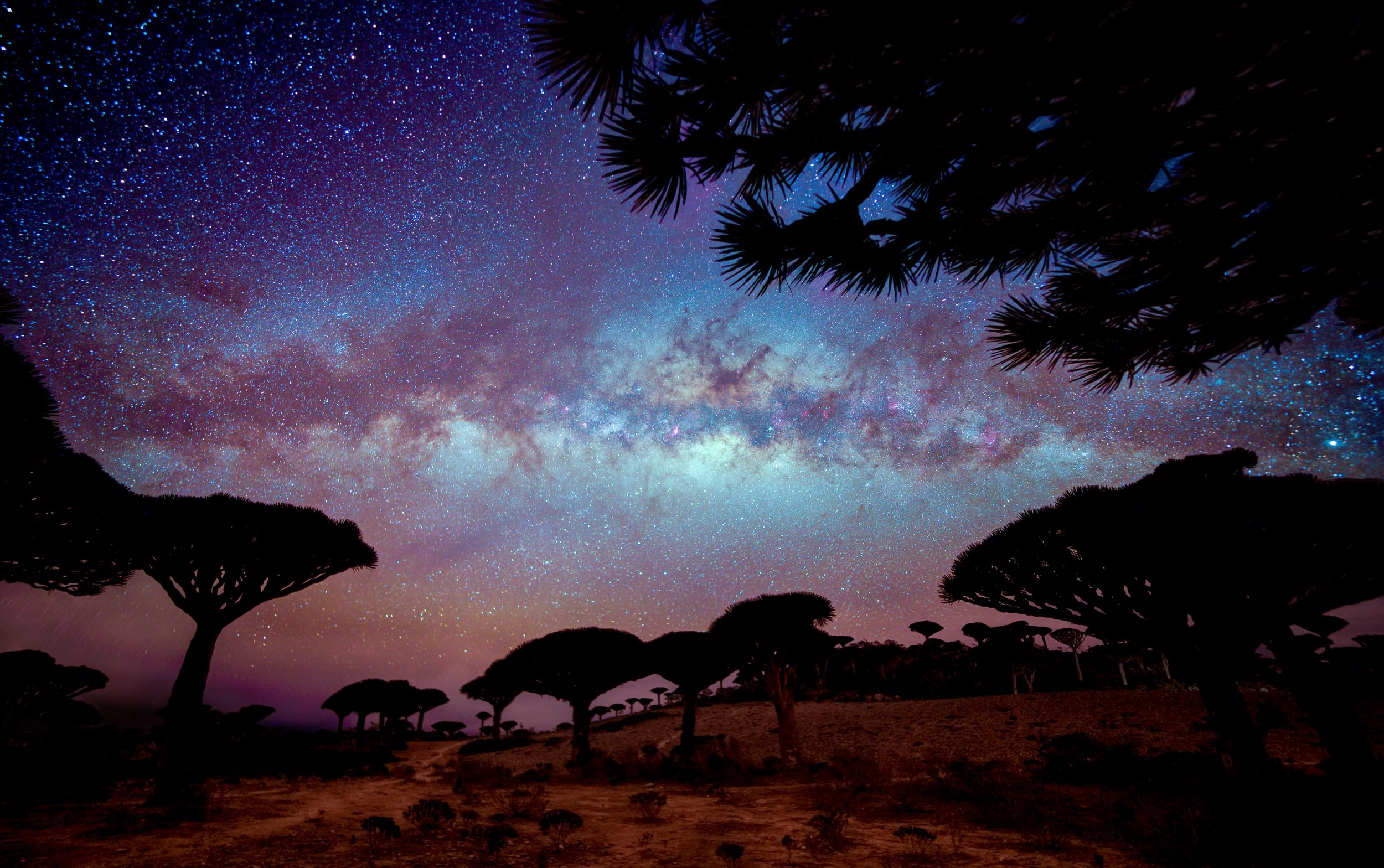
Dragons Blood Forest - Socotra, Yemen
What Is AstroTourism?
Astro-tourism is travel built around the night sky. It is a broad category, and that is part of its appeal. It can mean a night under a certified Dark Sky Park, a guided trip into the desert to photograph the Milky Way, or a stay at a ranch lodge that turns off its lights after dark so guests can see the stars. It can be as rugged as a sleeping bag on a canyon rim or as comfortable as a glass-domed cabin with the sky above your bed.
What ties every version together is intent. You are not just going somewhere and hoping to catch a few stars on a clear night. You are choosing a destination, a date, and a set of conditions specifically because of what the sky will show you.
The term has grown quickly into a recognized travel sector in the last decade. Destinations now market their dark skies the way beach towns market their coastlines. National parks run astronomy programs. Entire communities have changed their lighting to earn certification. The reason is simple: the night sky is one of the last genuinely wild views left on Earth, and it does not require a ticket, a passport, or a reservation to be moved by it.
It does, however, require you to be in the right place at the right time. That is what separates astro-tourism from just looking up on a random evening.
Why Travel to See the Stars at All?
Here is the honest answer: because most of us have never actually seen them.
If you live in or near a city, light pollution has been washing out the night sky for your entire life. You might count a few dozen stars on the clearest night. The Milky Way, that band of ancient light stretching across the sky, has simply never been visible from your backyard. Studies estimate that around 80 percent of people in North America cannot see the Milky Way from where they live. For many city dwellers, the number is closer to 99 percent.
I have watched the moment this sinks in for people more times than I can count. It is not a loud reaction. It is usually a long silence, then a quiet, disbelieving comment. The sky you have seen in photos, in movies, in your imagination, is suddenly right there, and it is bigger and more textured than any image captured it. People describe it as one of the most profound experiences of their lives, and I understand why. It is one of the few travel moments that genuinely shifts how you see your place in the universe.
There is a conservation angle here that matters to me personally. I am a delegate to DarkSky International and have worked in dark sky advocacy for years. Light pollution is not just an inconvenience for astronomers. It disrupts the migration of birds, the hunting patterns of nocturnal animals, and the natural cycles of insects. It has been linked to health problems in humans, from disrupted sleep to higher risks tied to our circadian rhythms. It wastes enormous amounts of energy. And it does all of this while robbing us of a view that every human being before the last century or so simply took for granted.
Traveling to see the stars is a way to experience something precious while it is still easy to reach. And the more people who see a truly dark sky, the more people who will care enough to protect it.
When Is the Best Time to See the Milky Way?
Timing is the part most people get wrong, and it is the difference between a magic night and a disappointing one.
The Milky Way core, the bright and densely packed center of our galaxy, is only visible during part of the year. In the Northern Hemisphere it is at its best from about March through October, with the peak in June, July, and August. During those months the core climbs high enough and stays up long enough to be easily seen in the evening hours. In the winter months, the core is largely below the horizon at night, and you mostly see the fainter outer arms of the galaxy.
The moon is the bigger variable, and it can erase the Milky Way entirely. A full moon is so bright that it scatters light through the atmosphere and washes out the faint dust lanes of the galaxy. The result looks like a clear but empty sky. For the best possible view you want the new moon, plus the few nights on either side of it, when the sky is at its darkest and the stars are at their most numerous.
This is why you will hear serious stargazers obsess over moon phases. A night that looks perfect on the weather app can still be a write-off if the moon is up. I plan every trip around the lunar cycle first and the calendar second. It is the single most reliable predictor of a great night under the stars.
You can check moon phases easily at timeanddate.com. For sky conditions, I rely on cleardarksky.com, which gives a detailed forecast for cloud cover, transparency, and seeing at specific observing sites. A truly good night combines three things: a new or nearly new moon, clear skies, and low humidity in the air.
Where to Go: Finding a Truly Dark Sky
Location decides everything, and not all dark-looking places are equal.
The first thing to understand is the scale of the problem. City glow can travel for dozens, even hundreds of miles. A "dark" rural area an hour from a major city may still sit under a dome of light pollution that dulls the sky. That is why certification exists. DarkSky International recognizes places that have taken real steps to protect their night skies, from parks to reserves to entire communities. When a site carries that designation, you know the sky there has been measured, protected, and kept genuinely dark.
The American Southwest is one of the best regions on Earth for this. It has high elevation, dry air, and vast stretches of protected public land far from major cities. It is no accident that some of the most famous dark sky destinations in the world sit in this region.
My home base of Las Vegas sits right at the edge of some exceptional country, which people outside the region find surprising. Within a short drive you can be under skies that rival anywhere on the planet. Las Vegas is genuinely a gateway to the stars, and it is a position I have come to appreciate more the longer I work in this field.
One tip that most people get wrong: Valley of Fire State Park, a spectacular daytime destination just outside Vegas, clears all visitors out at sunset. However good the sky looks, you cannot stargaze there at night. I have seen countless itineraries suggest otherwise, and it is simply not how the park works. The real play is the Mojave Desert south of the city. In the summer the Milky Way core sits low on the southern horizon, and being south of the city lights puts you on the right side of the glow for a clean, unobstructed view. It is a detail that matters, and it is the kind of thing you only learn by spending real nights out there.
Farther out, Utah is a stargazing heavyweight. The red rock country around Moab, the gateway towns to Zion, and the high desert of the Colorado Plateau all offer skies that stop people in their tracks. Arizona, with its dry air and established astronomy communities, and parts of New Mexico and California's high desert are excellent as well. Internationally, some of the clearest skies on Earth are found in the Atacama Desert of Chile and in parts of the Middle East and North Africa, where dry desert air keeps the sky unusually transparent.
Wherever you choose, the formula is the same. Get far from city light, find a certified or known-dark location, check the moon and the weather, and give your eyes time to adjust.
Who Is Astro-Tourism For?
Everyone. That is the honest answer, and I mean it more than most in this industry.
It works as a date or anniversary trip unlike any other. There is something quietly romantic about lying on a blanket under the Milky Way with someone, sharing the silence and the sheer scale of it. I have watched couples grow closer on these trips in a way that a nice dinner rarely achieves. It is memorable in a way that feels earned, not staged.
It is just as good for solo travelers. I meet a lot of people who come alone, either because their friends are not interested or because they simply prefer to travel that way. On a guided trip you are never truly on your own in the dark, and the group dynamic is part of what makes it work. It is a comfortable middle ground between full independence and structured group travel.
It also works for complete beginners, which is more common than you might think. You do not need to know a single constellation or own a single piece of gear. Some of the people most moved by the sky are the ones who come in with no expectations at all. If you are curious and willing to look up, you are qualified. That is the whole bar.
And it works across every budget. You can do it for the cost of a tank of gas and a night of camping, or you can do it as a full guided experience where everything is handled. Both are valid. The sky does not care how much you spent to get there.
What Do You Actually Need?
Less than you think, which surprises almost everyone.
You do not need a telescope. For simply seeing the sky, your eyes are the finest instrument available, and nothing you can buy will improve on the raw experience of dark-adapted vision under a truly dark sky. A blanket or a reclining camp chair, warm clothes for the desert night, and a red flashlight to protect your night vision are enough to have a genuinely profound evening.
Here is what few people realize: your night vision takes about twenty to thirty minutes to fully adapt, and it is ruined in an instant by a white light. That is why serious stargazers use red lights. It is not affectation. It is the difference between seeing the Milky Way in all its texture and seeing a washed-out version of it. Respect your dark adaptation and the sky will reward you.
If you want to photograph what you see, you do not need an expensive rig to start. A basic DSLR or mirrorless camera with a wide lens and a tripod will produce images that thrill you. What matters more than the camera is a steady mount and a willingness to learn the settings. Modern phone cameras, held on a small tripod with a long exposure, can capture a surprisingly good Milky Way too. Do not let gear stop you. Start with what you have, and upgrade when the images tell you to.
Why a Guide Is Worth It
Seeing the sky is one thing. Understanding it is another, and this is where the real value lives.
A good guide does not just point at constellations and name them. They tell you what you are looking at, why the sky behaves the way it does, and how to make sense of the apparent chaos overhead. They know the best locations, the right nights, and the local conditions that no website can fully capture. On my trips, people consistently tell me that the stories behind the stars are what they remember, not just the sight of them.
There is also a practical layer. I have spent years learning how to photograph the night sky, and helping someone get their first real Milky Way shot is one of the most rewarding parts of what I do. Watching that image come together on the back of a camera, under the very sky that produced it, is an experience people carry with them long after the trip ends. You leave with a skill and a photo, not just a memory.
If you are new to this, that guidance is the difference between a frustrating night of trial and error and a night where everything clicks. The learning curve is real, but it does not have to be yours alone.
Plan Your Own Night Sky Adventure
You can absolutely plan this on your own. Pick a new moon, find a dark sky site, check the sky forecast, and give it a real chance. The ingredients are all in this guide, and I genuinely believe everyone should experience an untamed night sky at least once in their life.
But if you want someone else to handle the timing, the location, the gear, and the knowledge, that is exactly what I do with Starlight Voyages. I run small, thoughtful trips into the darkest skies in the American Southwest and beyond, built around seeing the Milky Way and learning to photograph it. You meet us at the rendezvous point with your bags packed. We handle everything else, from the permits to the timing to teaching you how to capture what you are seeing.