
Stargazing Near Las Vegas: The Real Dark Sky Spots
When someone asks me where to stargaze near Vegas, I never give them the list you see on tourism sites. Most of those lists are wrong. They recommend parks that close at sunset. They confuse a scenic drive with an after-dark pullout. They send you to a locked gate.
This page is different. Every spot here is a place I have been to, or one that local astrophotographers and dark-sky regulars have confirmed. These are BLM roads, dry lake beds, wilderness edges, and viewpoints with parking that stay open. No gates. No rangers kicking you out. Just the Milky Way, the desert, and the kind of quiet that makes you forget you are 90 minutes from the Strip.
Las Vegas sits at the threshold of some of the darkest skies in the Lower 48. The Mojave Desert opens up south, east, and north of the city. Nevada has more public land than almost any other state, and most of it is BLM. You can pull off a dirt road, set up a chair, and watch the galaxy arc overhead. You just need to know where to go.
Two spots you will see on every other list, and why I am telling you to skip them:
Valley of Fire State Park clears all visitors at sunset. You cannot stay inside the park for stargazing unless you are camping in one of the two campgrounds, and even then, you are confined to the campground after dark. The gates lock. Red Rock Canyon closes its scenic loop at 5 p.m. (later in summer, but still before dark). You can stargaze from pullouts along SR-159 outside the loop, but you are still close to the city glow and passing headlights. There are better options.
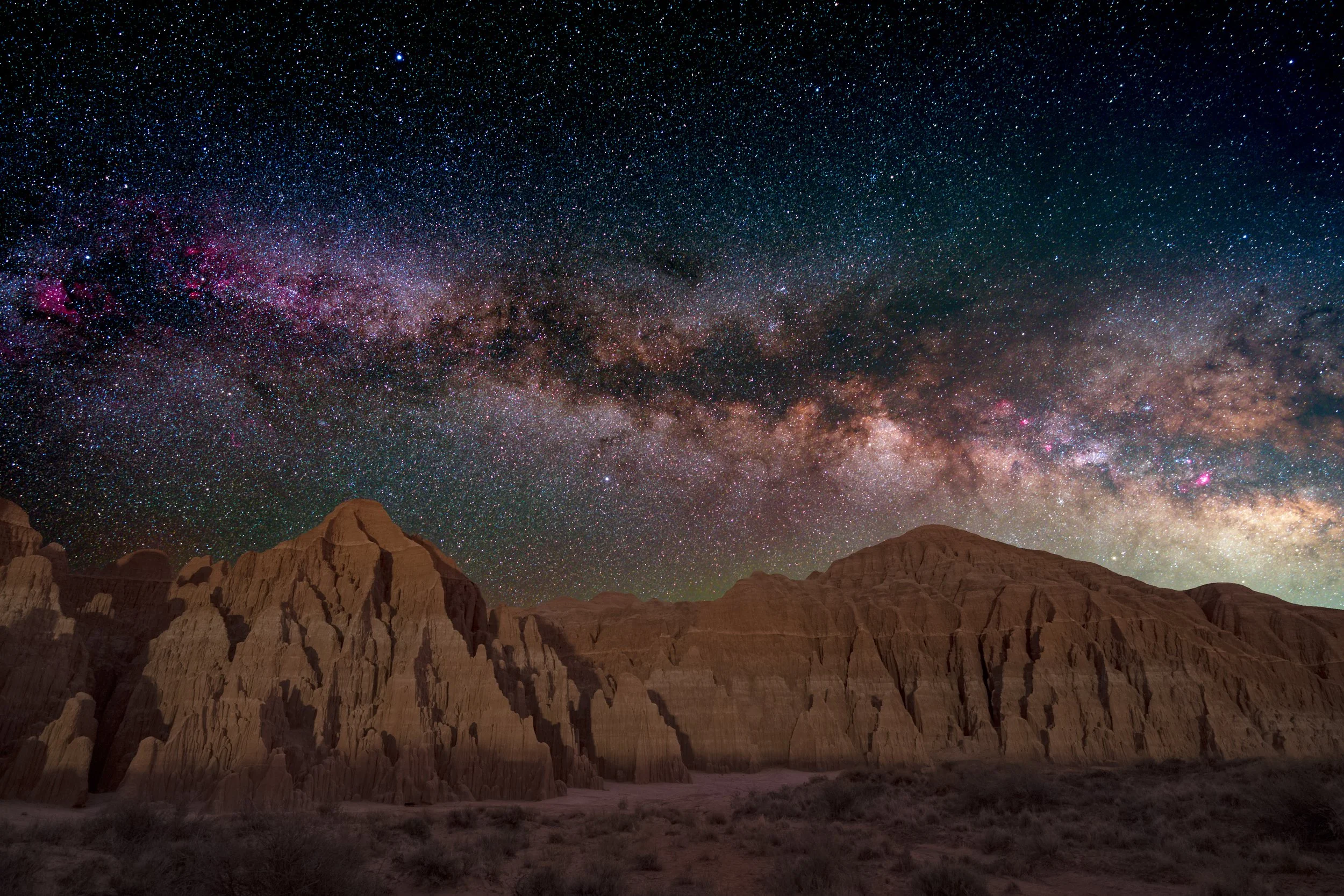
Cathedral Gorge State Park - Abdul Dremali
The Verified Spots
These are ordered roughly by distance from the Strip. The first is the closest, the last is the deepest trip. All of them are accessible at night. All of them are on public land. I have noted any road conditions or gear you will want.
Jean Dry Lake Bed (~35 min south, BLM, Bortle ~4)
The closest real escape from the Vegas light dome. Jean Dry Lake is a broad, flat playa south of the city off I-15, just past the Jean exit. The lake bed itself is public BLM land, completely open, and wide enough that you can walk far from the access road and get real darkness overhead. The playa surface is hard-packed when dry (do not drive on it after rain, it turns to clay soup).
This is the spot I recommend for a weeknight quick hit. You will not get Bortle 1 skies here, but on a clear night with no moon, the Milky Way is visible to the naked eye. Look south and southwest. The city glow sits behind you to the north. Bring a chair and a red headlamp. The access point is near the Seven Magic Mountains art installation, so you can find it easily on any map app. Just keep going past the art piece toward the dry lake bed.
Access: Paved road to the approach, then packed dirt/sand onto the playa. 2WD friendly when dry. No facilities. No water. No cell signal on parts of the lake bed.
Nelson's Landing Area (Colorado River Overlook) (~45 min southeast, BLM wilderness adjacent, Bortle ~3)
Take US-95 south toward Searchlight, then hang a left on SR-165 toward Nelson. Drive past the Nelson Ghost Town (cool to visit during the day, but the mine tour is private) and keep going toward the river. The road ends at the Colorado River overlook near Nelson's Landing. The stretch of SR-165 beyond the ghost town rises into the Eldorado Wilderness boundary and the Lake Mead National Recreation Area edge. There are pullouts along this road with unobstructed sky and a real sense of isolation.
This spot was flagged by local astrophotographers as a designated dark skies area. The elevation gain as you climb toward the river gives you some altitude, and the Colorado River corridor opens the southern sky. In summer, the Milky Way core sits right over the river. It is quiet enough out here that you will hear coyotes while you shoot.
Access: Paved road all the way to the river. Pullouts are gravel. No facilities past Nelson. Watch for boats and trailers near the landing during the day; at night, you will likely be alone. The road is winding and unlit, so drive carefully on the way back.
Wee Thump Joshua Tree Wilderness (Avi Kwa Ame National Monument) (~1 hour south, BLM, Bortle ~2-3)
This is the one I tell people about when they want the full experience. Wee Thump (ancient ones in Paiute) is a 6,489-acre wilderness of old-growth Joshua trees within the Avi Kwa Ame National Monument, designated in 2023. It sits about eight miles west of Searchlight, off State Route 164 (Joshua Tree Highway). The wilderness itself is vehicle-free, but a network of dirt boundary roads runs the perimeter, and there are campsite pullouts with open sky views.
The Joshua trees here are hundreds of years old, some over 30 feet tall. At night, silhouetted against the Milky Way, they make for one of the most surreal stargazing backdrops in the Mojave. I have shot here more times than I can count. The elevation (4,000 to 5,000 feet) helps with clarity, and the darkness is real. You are about an hour from the Strip, but it feels like a different planet.
Access: From US-95 at Searchlight, take SR-164 west for 8.2 miles to Wee Thump East Road (dirt, marked by a stop sign). High-clearance recommended for the boundary roads. 4WD not required but helps. The 15-mile loop around the wilderness perimeter is doable in a SUV. Dispersed camping allowed. No water, no facilities. Watch for washouts after rain.
Searchlight BLM (Walking Box Ranch Road Area) (~1 hour south, BLM, Bortle ~3)
Searchlight is a small town about 55 miles south of Vegas on US-95. The land around it is almost entirely BLM. The stretch of SR-164 westbound toward Nipton is lined with dispersed camping areas and pullouts. Walking Box Ranch Road, about 7 miles west of Searchlight, takes you into the historic Walking Box Ranch area (once owned by silent film stars Rex Bell and Clara Bow). The ranch itself is not open to the public, but the BLM roads around it are fair game.
This area is popular with Las Vegas Astronomical Society members and local astrophotographers who want a quick, reliable dark-sky site without the deeper drive to Amargosa. The elevation is around 3,500 to 4,000 feet, and the air is dry. You can pull off nearly any side road, set up, and shoot. Just stay off private property (the ranch compound is fenced and marked).
Access: Paved highway to Searchlight, then graded dirt roads. Most 2WD vehicles can handle the main roads. The deeper you go, the rougher it gets. Use a map app with offline mode. No cell service in many spots. No facilities.
Amargosa Valley & Big Dune (~1.5 hours northwest, BLM, Bortle ~2)
This is the crown jewel of near-Vegas stargazing. Amargosa Valley sits on the edge of Death Valley National Park, and Big Dune is a BLM-managed recreation area with five square miles of sand dunes rising to about 500 feet. The skies here are Bortle Class 2. On a moonless night, the Milky Way casts a shadow. You can see Andromeda with the naked eye. The air is so dry and clear that the stars seem to have edges.
From Las Vegas, take US-95 north for about 95 miles. Turn left on Valley View Road, go 2.2 miles, then left onto a dirt road to the dunes. The area is open 24/7 with a 14-day stay limit for dispersed camping. It is popular with off-roaders on weekends, so go midweek if you want solitude. In summer, the Milky Way core rises over the southern horizon late in the evening. The dunes themselves make a spectacular foreground for astrophotography.
This is where I take people who have never seen a truly dark sky. The drive is easy, the reward is total. Just check the moon phase before you go. A full moon will wash out the Milky Way even here.
Access: Paved US-95 to Valley View Road (paved), then dirt road to the dunes. High-clearance recommended for the last stretch. 2WD can make it if conditions are dry, but you will want to park before the deep sand. No water. No facilities. No cell service. Bring everything you need.
Tonopah Stargazing Park (~3.5 hours north, certified dark sky, Bortle ~1-2)
Tonopah is the deep trip. Voted the #1 stargazing destination in America by USA Today, it sits at over 6,000 feet elevation in central Nevada, surrounded by hundreds of miles of basin and range. The town has a public stargazing park (Clair Blackburn Memorial Stargazing Park) that is free, open 24/7, and has concrete pads for telescopes, benches, and red-filtered lighting. It is a purpose-built dark-sky facility.
This is not a quick drive from Vegas. It is a commitment. But the skies here are among the darkest in the United States. The Milky Way is bright enough to navigate by. The town itself has retrofitted its streetlights to dark-sky-friendly amber, so even staying in Tonopah overnight keeps you in dark-sky territory. The Mizpah Hotel is a historic spot to crash after a long night under the stars.
If you are serious about stargazing and can spare a full night, Tonopah is the play. Pair it with a visit to the nearby Lunar Crater volcanic field (BLM land, also incredibly dark) and you have a weekend of the best skies in the country.
Access: US-95 all the way north. Fully paved. The stargazing park is at the north end of town. Facilities (benches, pads, porta-potties). No fee. Dress warm, even in summer: at 6,000 feet, nights get cold.
Summer Milky Way tip: From May through September, the Milky Way galactic core sits low on the southern horizon in the evening. That means you want to be south of Las Vegas, so the city light dome is behind you and the core rises in clean dark sky ahead of you. Spots 1, 2, 3, and 4 on this list put you on the right side of the city for summer Milky Way viewing. In winter, the galactic core is not visible, but the winter constellations (Orion, Taurus, Gemini) are spectacular. Amargosa and Tonopah are great year-round.
What to Bring
Red headlamp or flashlight. White light destroys your night vision for 20 to 30 minutes. Red preserves it. Every astrophotographer I know runs red.
Layers. The desert drops 20 to 30 degrees after sunset. Even in July, a 2 a.m. session in the Mojave gets cold.
Water and snacks. None of these spots have facilities. Bring more water than you think you need.
Offline maps. Cell service is spotty or nonexistent at most of these locations. Download the area in Google Maps or Gaia GPS before you leave.
A chair or blanket. You will be looking up for a while. A reclining camp chair is worth its weight in gold.
Check the moon phase. A full moon washes out everything except the brightest stars. Plan around the new moon, or go when the moon sets before midnight.
Tell someone where you are going. These are remote spots. If your car breaks down or you get stuck, you want someone to know where to look.
Abdul Dremali is an astrophotographer, delegate to DarkSky International, and founder of Starlight Voyages. He lives in Las Vegas, Nevada, and has spent years exploring the dark skies of the Mojave Desert. For guided astro-tours and workshops, visit starlight-voyages.com.
Last updated: September 6, 2026. All access information verified as of this date. Conditions change, roads wash out, and BLM policies can shift. Check current conditions before you go.