
When to See the Milky Way in 2027
Most people get the Milky Way question wrong. They ask where. The real answer is when.
The bright core of the Milky Way, that fat glowing band with the dark dust lanes running through it, is not up all year. From the Northern Hemisphere it swings into view around late February and disappears again by late October. Show up to a dark desert sky in January hoping for the galactic center and you will get a gorgeous winter sky full of Orion and Taurus, and zero Milky Way core. I have watched people do it. It is like flying to Rome and asking where the Eiffel Tower is.
The short answer for 2027: plan your trip between March and October, and line it up with a new moon. That is the whole trick. Season for the when, new moon for the dark, clear dry air for the sharpness. Nail all three on one night and the Milky Way will stop you in your tracks.
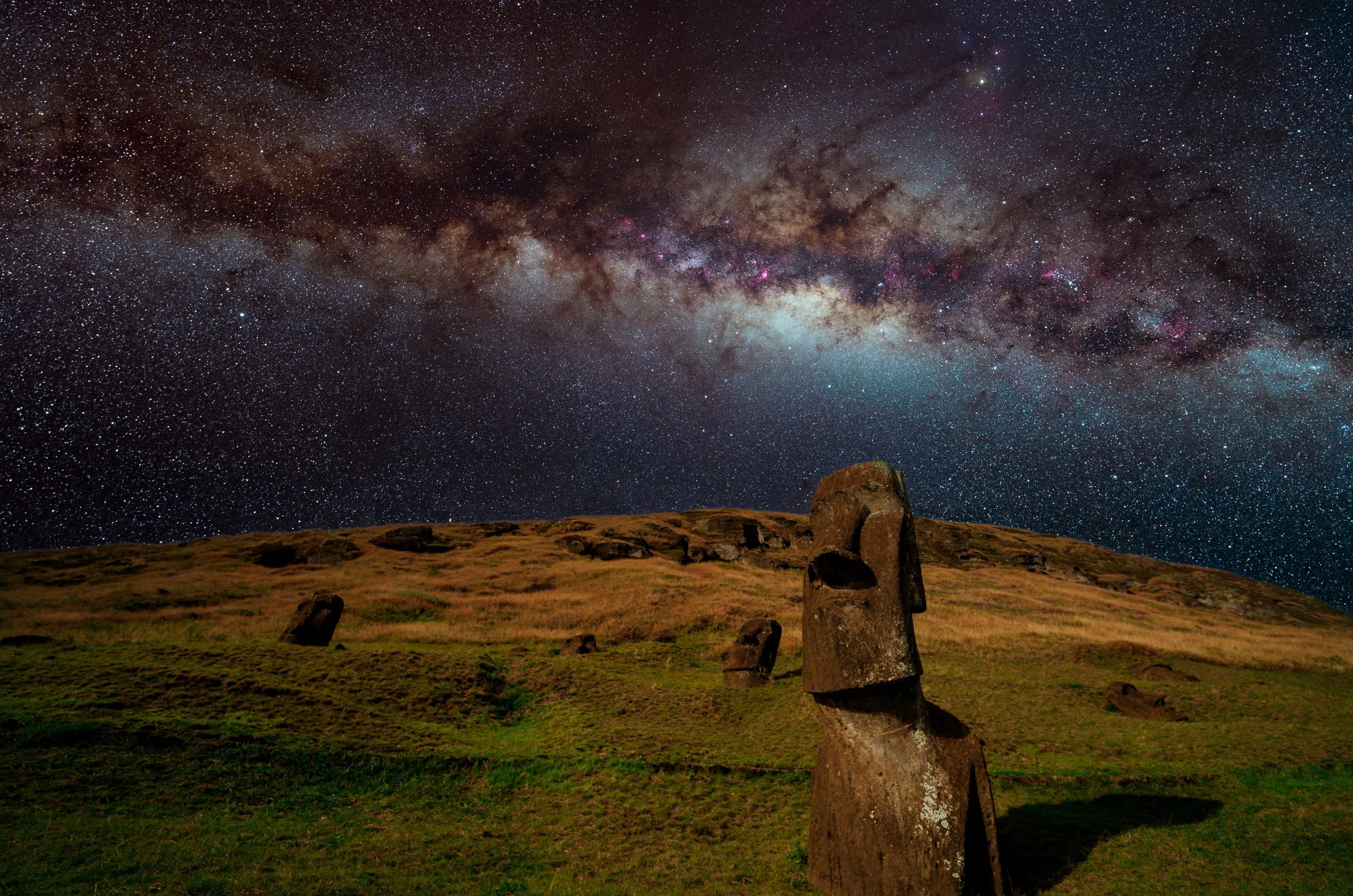
Rapa Nui (easter island) Ranu Raraku by Abdul Dremali
When is Milky Way season in 2027?
Milky Way season is shorthand for the window when the galactic core, the brightest, densest, most photogenic chunk of our galaxy, sits above the horizon at night in the Northern Hemisphere.
That window runs roughly February through October. The core rises in the southeast before dawn in late winter, climbs higher and earlier each month, reaches its prime position due south in June and July, then sinks toward the southwest and sets earlier through the fall until it is gone by early November.
From November through January the core simply is not up at night. The sun sits between us and it. You can still see the dimmer winter arm of the Milky Way and a sky full of bright stars, but the showpiece, the bulge around Sagittarius, is below the horizon.
So the practical core season in 2027 is March through October. June and July are the peak. That is when the core rides highest and stays up the longest.
Why the moon decides everything
This is the part most beginners skip, and it is the part that matters most.
The Milky Way is faint. Your eyes, and your camera, need real darkness to pull the detail out of it. The single brightest object in the night sky is the moon, and a full moon floods the sky with the equivalent of a light pollution dome no matter how far from the city you drive.
Think of it this way. On a moonless night under truly dark skies you can pick out a few thousand stars, and the Milky Way dust lanes look three dimensional. You can see the dark rift that splits the galaxy, the bulge, the structure. Add a full moon and that same sky collapses to a few hundred stars and a washed out haze. The galaxy disappears into the glow.
A new moon is the exact opposite. The moon rises and sets with the sun, so it is simply not in the night sky at all. You get darkness from dusk to dawn. That is why every serious stargazer and astrophotographer I know, and every trip I run, gets built around the new moon.
The window around a new moon is more forgiving than people assume. The three or four nights on either side are still plenty dark, especially once a thin crescent sets early. You do not need the exact night. You need to avoid the week of the full moon and the fat gibbous days just before it.
The 2027 new moon calendar for the Milky Way
Here are the new moon dates for 2027 that fall inside Milky Way season. These are the nights to circle.
New moons inside Milky Way season:
March 8, 2027
April 6, 2027
May 6, 2027
June 4, 2027
July 3, 2027
August 2, 2027
August 31, 2027
September 29, 2027
October 29, 2027
August gets two new moons in 2027, on the 2nd and the 31st. That is a rare double bite at peak season, and worth noting if you can only travel late summer.
The two nights I would fight hardest for are June 4 and July 3. Those new moons land right on top of peak core season, when the galactic center is highest in the sky and visible for the biggest chunk of the night. If 2027 gives you one window, take one of those.
Now the flip side, the dates to dodge. These are the full moons inside core season, when the galaxy gets washed out no matter where you stand.
Full moons to avoid: (unless you’re into that sort of thing?)
March 22, 2027
April 20, 2027
May 20, 2027
June 19, 2027
July 18, 2027
August 17, 2027
September 15, 2027
October 15, 2027
Book your trip on the first list, not the second. It is that simple.
The best months and hours in 2027
When you go changes what you see, and where to look. Here is the month by month shape of it from a Northern Hemisphere latitude like the American Southwest.
March and April: the core rises in the southeast a couple hours before dawn. You are out at 4 or 5 AM. Cold, but the galaxy sits low and dramatic near the horizon, which makes for big compositions if you have a foreground.
May: the core is up higher and earlier. The 2 to 3 AM window is your sweet spot. This is the month the full arc of the galaxy starts to stretch across the sky.
June and July: prime time. The core sits due south and rides high. From a dark site you can see it from roughly midnight through the early morning. If I could only pick one month in 2027 it is July.
August: the core is still high at nightfall but starting to drift west. You can catch it comfortably right after dark, which is nice for anyone who does not want to pull a 3 AM alarm.
September and October: the window flips to early evening. The core sits in the southwest and sets fast. Be out as soon as it is fully dark, or you will miss it.
Direction cheat sheet: early season look southeast, peak season look south, late season look southwest.
One thing that surprises people. You do not need a telescope. The Milky Way is a naked eye object, and that is the entire point. Your eyes are the instrument. A cheap pair of binoculars is a nice bonus for poking through the core and finding star clusters, but nobody buys a telescope to see the Milky Way. They buy a tank of gas to get away from the lights.
The desert rule: clear skies, new moon, low humidity
Season and moon phase are only two thirds of it. The third piece is the air itself, and this is where living in Las Vegas gives me an unfair advantage.
The ideal Milky Way night is clear skies, new moon, and low humidity. Water vapor in the air scatters light and softens the stars. Dry desert air is transparent in a way humid coastal air never is. That is why the world great observatories sit in deserts, Chile, Arizona, the Mojave. Dry air means crisp stars and a galaxy that looks carved into the sky.
The Mojave delivers all three at once. I live about 45 minutes from genuine dark sky, and that is the whole reason I built Starlight Voyages here. The city is the gateway, not the destination.
Planning a trip out this way? Valley of Fire State Park is gorgeous, but the park clears visitors at sunset and there is no after-dark access. People search Valley of Fire stargazing constantly and it simply is not a thing. If you want the Milky Way near Vegas, head south into the Mojave instead. In summer the galactic core sits low on the southern horizon, so sites south of the city give you a clean view of the core right at its brightest angle.
Before you commit to a night, check the forecast. I use cleardarksky.com and Clear Outside for transparency and seeing. And pull up lightpollutionmap.app to find a Bortle 2 or 3 site within driving distance. A green or blue zone on that map is where the Milky Way stops being a rumor and starts being a physical thing you can almost touch.
How I plan trips around the lunar cycle
I build everything backwards from the moon.
Every trip I run for Starlight Voyages starts with the lunar calendar first and the destination second. That is the order that matters. A world class dark sky site on a full moon is just a nice place to look at a bright moon. A decent dark site on a new moon is a night you remember for the rest of your life.
So I find the new moon windows for the year, the list you now have for 2027, and then I ask where the weather and the season line up best on those exact dates. June and July new moons mean the Mojave, the high desert, the Colorado Plateau. September and October new moons open up warmer, more forgiving nights. It is all one long calculation between the moon, the season, and the forecast.
If you remember nothing else, remember the formula. Clear skies plus new moon plus low humidity, inside the March to October core season. Get those four things on the same night and the Milky Way will do the rest.
Save the 2027 new moon dates above. Circle June 4 or July 3. Drive out of the city until the map turns dark. Then look south.