
Stargazing for Non-Photographers: How to Experience the Dark Skies of the American Southwest
While astrophotography showcases the vivid colors of distant nebulae through long-exposure sensors, naked-eye stargazing offers something a camera screen can never replicate: true immersion. Standing beneath a pristine, unpolluted sky—watching the core of the Milky Way arch over desert sandstone while shooting stars streak across your peripheral vision—is a deeply grounding, prehistoric human experience.
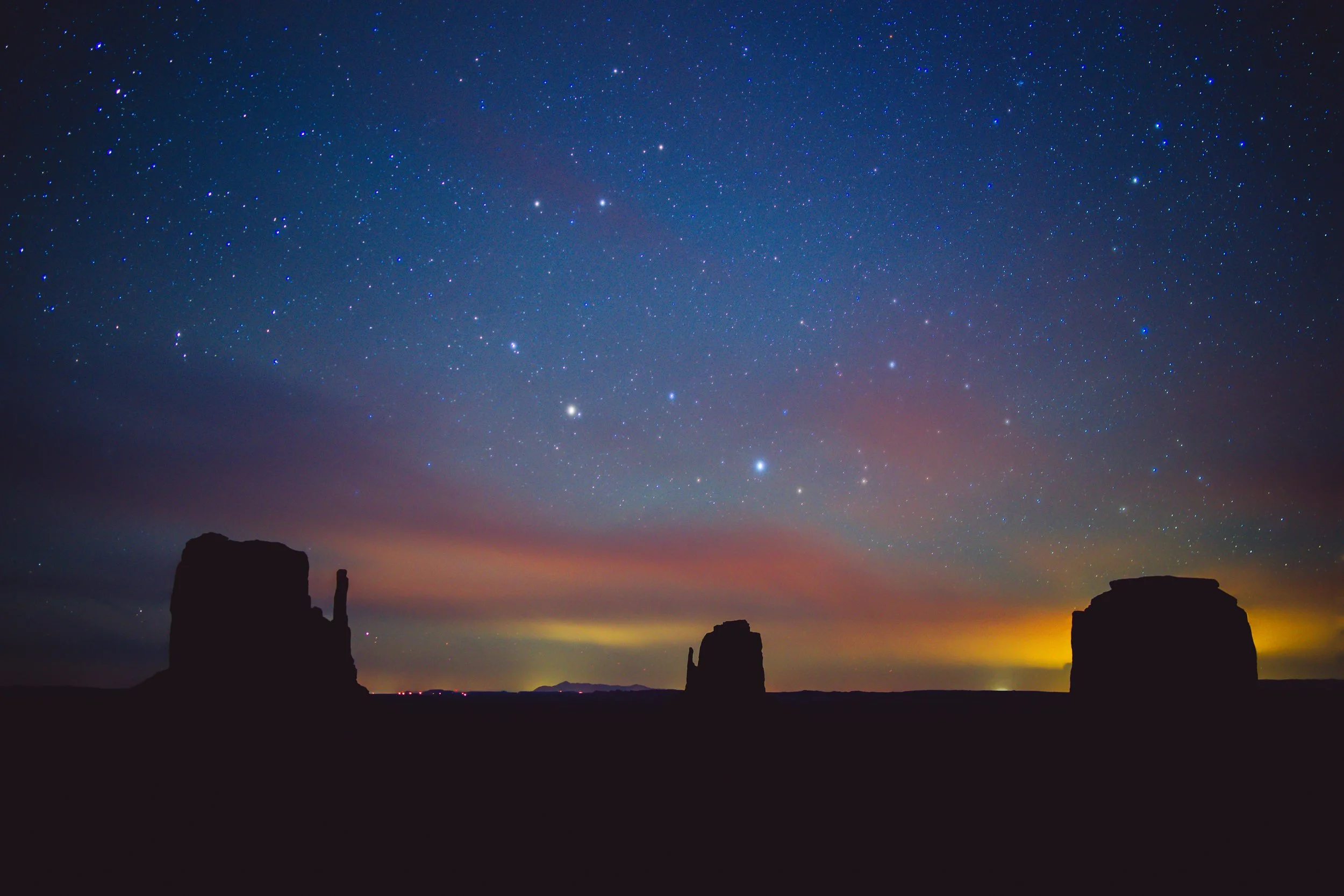
The American Southwest contains some of the darkest, most accessible patches of night sky left in North America. If you are basing your journey out of Las Vegas, Nevada, or Salt Lake City, Utah, you are only a few hours’ drive away from celestial views that 80% of North Americans can no longer see from their backyards.
Here is your complete guide to finding, viewing, and enjoying the Southwest’s dark skies—no photography gear required.
1. The Bortle Scale: How to Measure True Darkness
When planning a stargazing trip, you will often see locations measured by the Bortle Dark-Sky Scale. Created by astronomer John E. Bortle, this nine-level numerical scale measures the night sky's brightness and how light pollution impacts your ability to see celestial objects.
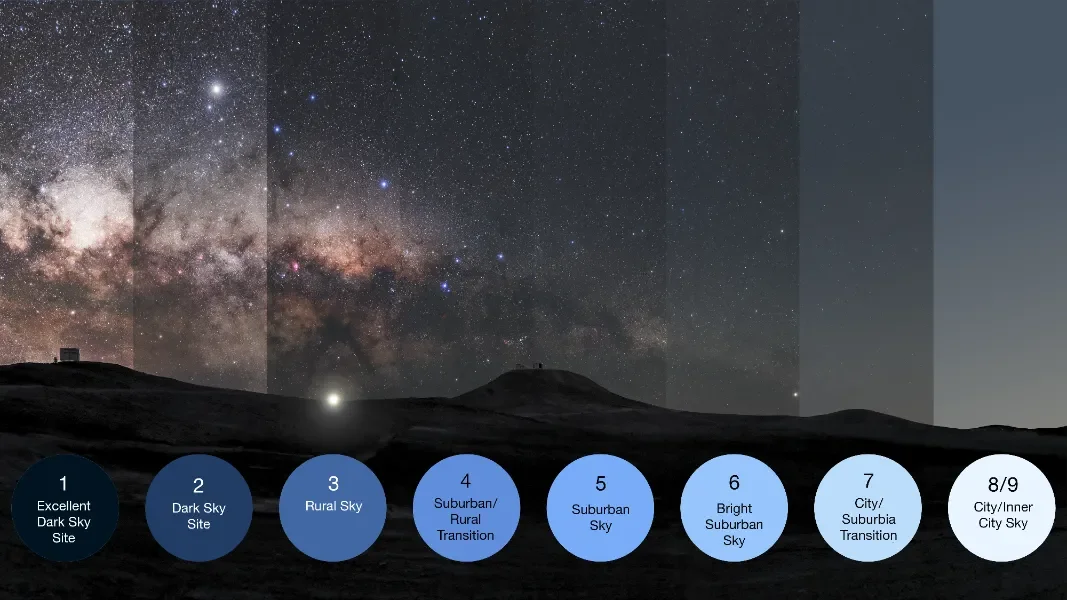
Source: LightPollutionMap.app
Class 1 & 2
Truly Dark / Typical Truly Dark
Milky Way casts obvious shadows on the ground; zodiacal light is bright; thousands of individual stars visible.
Great Basin National Park, remote parts of Death Valley, Grand Canyon Parashant
Class 3 & 4
Rural / Semi-Rural Sky
Milky Way shows rich detail; some light domes visible on the far horizon; satellites and shooting stars easily spotted.
Valley of Fire perimeter, Moapa Valley, outskirts of Joshua Tree
Class 5 & 6
Suburban Sky
Milky Way is faint or washed out; constellations are visible but faint background stars are lost.
St. George outskirts, Pahrump
Class 8 & 9
Inner-City Sky
Only the Moon, bright planets (Venus, Jupiter, Mars), and a few prominent stars (Orion's belt, Polaris) are visible.
Downtown Las Vegas, Salt Lake City metro
Direct Takeaway: For a world-class stargazing experience where the Milky Way is bright and distinct to your natural eyes, aim for locations rated Bortle Class 1, 2, or 3.
2. Top Dark-Sky Locations Near Las Vegas and Southern Utah
You don’t have to hike into the backcountry for days to find pristine skies. These accessible locations provide incredible vistas within a half-day drive from major Southwest hubs.
A. Valley of Fire State Park & Moapa Valley, Nevada (Bortle Class 2–3)
Drive Time from Las Vegas: ~1 hour (55 miles northeast)
The Experience: While the day brings blazing red Aztec sandstone, the night brings total serenity. Because the park closes to day-use visitors at sunset, overnight campers get exclusive access to dramatic rock silhouettes framed against star-dense skies.
Pro-Tip: If park campsites are full, the adjacent public BLM lands near Moapa Valley offer wide-open horizons with minimal light interference.
B. Death Valley National Park (Bortle Class 1–2)
Drive Time from Las Vegas: ~2 to 2.5 hours west
The Experience: Designated as an International Dark Sky Park by DarkSky International, Death Valley boasts some of the darkest skies in the United States. Locations like the Mesquite Flat Sand Dunes or Harmony Borax Works offer 360-degree panoramic sky views unobstructed by trees or mountains.
C. Great Basin National Park, Nevada (Bortle Class 1)
Drive Time from Las Vegas: ~4.5 hours north along US-93
The Experience: Widely regarded as one of the quietest and least-visited national parks, Great Basin's high elevation (ranging from 6,825 to over 13,000 ft) puts you above much of the atmospheric haze. Under these Bortle 1 skies, the Milky Way doesn't look like a faint cloud—it appears three-dimensional.
D. Mojave Desert
Drive time from Las Vegas: ~1.5 Hours south
During the summer months this is one of the easiest ways to see the Milky Way Core from Vegas. Just head south on i-15 until it gets dark!
3. Naked-Eye Stargazing: What Can You Actually See?
A common myth is that without a telescope or camera, the sky looks like a flat black sheet with white dots. In a Bortle Class 1 or 2 zone, your eyes will register phenomena you may have never seen before:
The Galactic Core: Visible from late spring to early autumn (March through October), the center of our galaxy looks like an expansive, luminous cloud laced with dark cosmic dust lanes (the "Great Rift").
Airglow: A subtle, natural luminescence of the Earth's upper atmosphere that prevents true dark sky areas from ever being 100% pitch black.
The Andromeda Galaxy (M31): The most distant object visible to the naked human eye—approximately 2.5 million light-years away—appearing as an elongated, smudgy oval of light.
Zodiacal Light: A triangular beam of sunlight scattered by interplanetary dust, visible in the western sky after evening twilight in spring or the eastern sky before morning dawn in autumn.
Satellites & Meteors: On any clear night in the desert, you can expect to spot multiple shooting stars per hour and track low-Earth-orbit satellites gliding silently overhead.
The addition of even normal small binoculars can make a massive difference, especially when looking at targets like Jupiter!
4. Packing & Preparation: Comfort is Everything
Stargazing is a stationary activity. In desert environments, temperatures plummet rapidly the moment the sun drops below the horizon. If you are cold or uncomfortable, your night will end early. I hate being cold so this part is important to me!
Essential Stargazing Gear Checklist:
Red-Light Headlamp or Flashlight: White light immediately ruins your night-vision adaptation (which takes 20–30 minutes to build). Red light preserves your eyes’ sensitivity to faint starlight. I use a few different brands of headlamps but really love my Nitecore NU30 for stargazing and astrophotography.
Zero-Gravity Recliner or Inflatable Lounger: Looking straight up while standing strains your neck within minutes. A reclining camp chair keeps your field of view aimed at the zenith effortlessly.
Layered Thermal Clothing: Even during summer months, high-desert nights frequently drop into the 40s and 50s (°F). Pack a windbreaker, fleece, warm beanie, and wool socks.
Standard 7x50 or 10x50 Binoculars: You don’t need an unwieldy telescope. A simple pair of binoculars will reveal Jupiter’s four largest moons, craters on our Moon, and shimmering star clusters like the Pleiades (Seven Sisters).
Offline Astronomy Apps: Apps like SkySafari, Stellarium, or Star Walk 2 allow you to hold your phone up to identify constellations. Crucial: Turn your phone’s display to night/red-mode and reduce brightness to minimum.
Handwarmers! I pack a ton of body-warmers and hand warmers.
5. Timing Your Adventure: Moon Phases Matter Most
The biggest mistake first-time stargazers make is planning a trip during a full moon.
A bright moon acts like natural light pollution, washing out the Milky Way and faint stars just as severely as city streetlights.
Best Time to Go (The New Moon Window): Plan your stargazing trips during the New Moon phase, or during the week before and after it, when the moon rises late or sets early.
Weather & Seasons:
Spring/Summer/Fall: Best for viewing the bright core of the Milky Way.
Winter: Offers crisper, clearer atmospheric viewing of brilliant constellations like Orion, Taurus, and the Sirius star system.
6. Self-Drive vs. Guided Stargazing Voyages
While independent road-tripping is rewarding, navigating remote desert dirt roads at 1:00 AM comes with logistical hurdles: spotty cellular reception, lack of facilities, sudden temperature shifts, and permit restrictions on public lands.
Joining an organized small-group expedition bridges the gap between rugged nature and comfort:
Curated Dark-Sky Camps: Enjoy comfortable glamping setups, warm fires, warm drinks, and seating ready the moment you arrive.
Expert Sky Interpretation: Learn the ancient mythology, science, and navigation methods behind the constellations from passionate guides who know the terrain.
Zero Photography Pressure: At Starlight Voyages, our domestic trips cater equally to visual stargazers and astrophotographers. Whether you want to learn advanced camera techniques alongside a pro or simply sink into a zero-gravity chair with hot tea and take in the cosmos, you get an unhurried, boutique desert experience.
Frequently Asked Questions (FAQ)
Do I need any special equipment to enjoy a stargazing trip?
No. All you need is warm clothing, a red-light headlamp to protect your night vision, and a comfortable chair or blanket. Binoculars are optional but add incredible depth to your viewing.
Can I see colors in the Milky Way with my naked eye?
Human eyes rely on rod cells for low-light vision, which see in shades of grey, silver, and soft white rather than vivid pinks and purples. While cameras capture intense color over 20-second exposures, the naked-eye view provides a silver, textured cloud that stretches from horizon to horizon.
Where is the darkest sky closest to Las Vegas?
The closest accessible dark-sky zone is the area surrounding Valley of Fire / Moapa Valley (approx. 50–60 minutes away), which offers Bortle Class 2–3 skies. For true Bortle Class 1 darkness, Death Valley or Great Basin National Park are the best options within driving distance.
Experience the Cosmos with Starlight Voyages
Ready to trade city lights for a canopy of millions of stars? Explore our upcoming Domestic Stargazing Voyages to reserve your spot on our next Southwest desert journey.